
Concrete coatings for Bismarck-Mandan homes and shops
Epoxy Flooring in Bismarck, ND
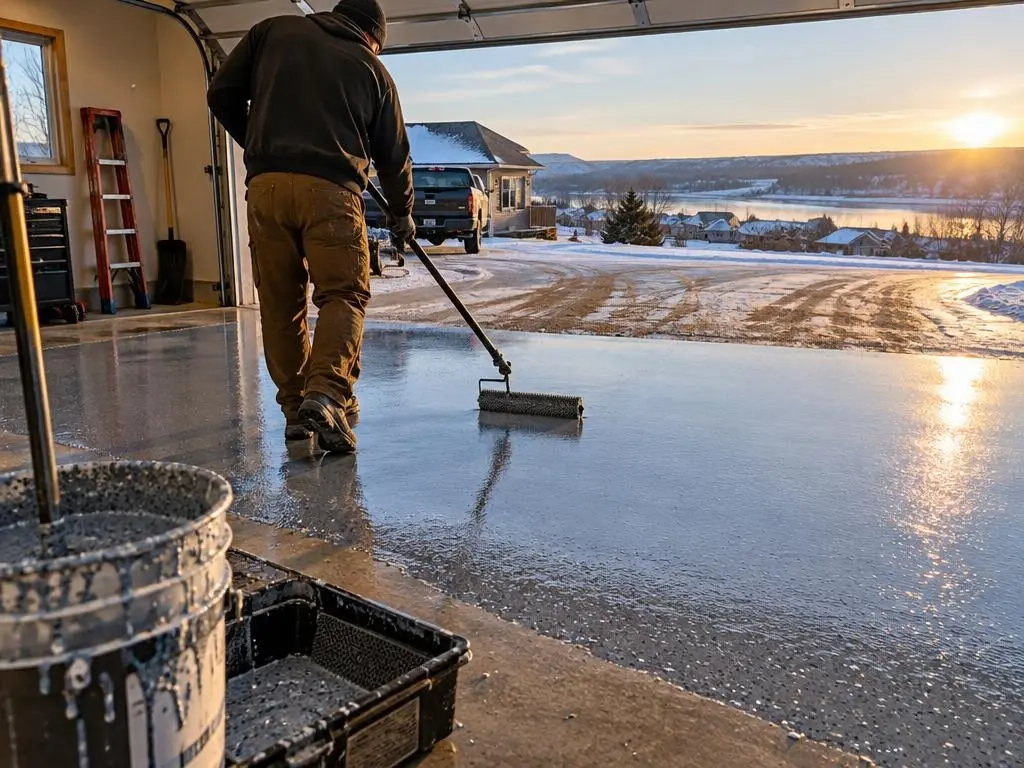
Garage, shop and basement floors prepared for winter brine, tracked-in sand and long stretches of subzero cold.
- Free on-site estimate with a slab moisture test
- Full diamond grind on every floor, edges and corners included
- Itemized written quote that lists each coat and the total
Coated Floors Built Around a Missouri Slope Winter
Epoxy flooring in Bismarck has to handle a long, cold, gritty winter. Wikipedia lists Bismarck's average snowfall at about 50.5 inches a year, a January daily mean of 12.8 °F, and a record low of −45 °F. Every snowfall means plows and treated roads, and whatever is on the road ends up on your garage floor. A coating here has to stay bonded through months of hard cold at the overhead door and still clean up easily when the slush melts off the car.
What comes in on your tires
Bismarck treats its streets with a mix of materials. During the 2021 to 2022 winter, KFYR-TV reported the city had used nearly 38,000 gallons of beet brine, more than 17,000 gallons of salt brine, 190 tons of salt and more than 2,300 tons of sand. That combination does two kinds of damage. The brine and salt soak into bare concrete, and a South Dakota DOT literature review prepared by the Michigan Tech Transportation Institute in 2008 found sodium chloride causes severe scaling under freeze-thaw cycling. The sand is abrasive. Ground under tires and boots, it scratches and dulls whatever finish is on the floor. We plan for both by bonding the coating to ground concrete and finishing with a hard, chemical-resistant topcoat.
Newer slabs, bigger garages
Bismarck's housing is younger than many Midwest cities. American Community Survey figures summarized by Point2Homes put the median year built at 1985, with about 19% of homes built between 2010 and 2019 and another 12% from the 2000s. Wikipedia notes that much of the city's recent residential growth has come on the north side. Newer houses usually mean attached two- and three-stall garages with slabs in decent shape. Decent shape does not mean ready to coat. New concrete often carries a cure-and-seal product that has to be ground off, and builder slabs commonly have shrinkage cracks along the control joints. The older 1970s and earlier neighborhoods closer to downtown have their own issues: patched slabs, old paint, and cracks that have moved for decades.
Basements, humidity and radon
Wikipedia describes Bismarck summers as warm and humid, with an annual average relative humidity of 66.4%. The EPA advises keeping indoor humidity below 60%, ideally between 30% and 50%, and notes that condensation forms where warm, humid air meets a cold surface. A basement slab in July can be exactly that surface. We test for moisture before recommending any basement system. North Dakota also has a radon problem: the state Department of Environmental Quality reported in January 2026 that 63% of North Dakota homes have radon above the EPA action level. A floor coating is not a radon system, so we recommend a radon test before you finish a basement.
The systems we install
- Epoxy base with a polyaspartic topcoat: a thick, well-bonded base coat with a UV-stable, abrasion-resistant top layer.
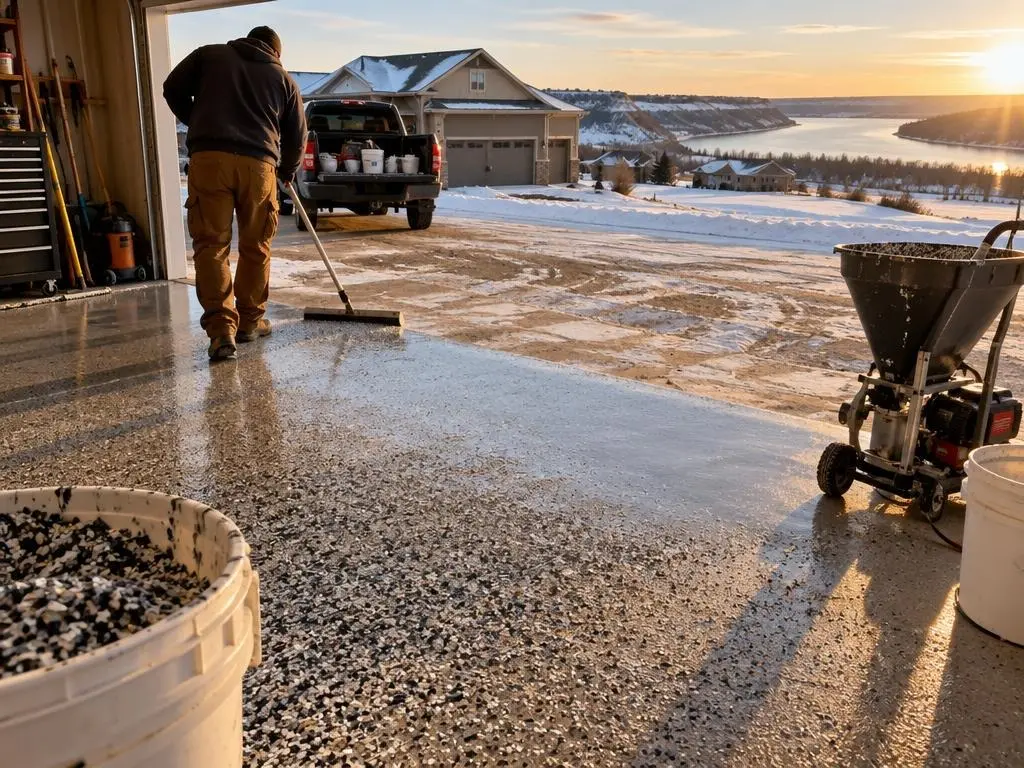
- Full flake broadcast: colored chips scattered into the base to full coverage, which hides sand and salt residue and adds grip.
- Polyaspartic systems: quick-curing coats that shorten the time your garage is out of service and that HomeGuide says can go down across a wide temperature range.
- Metallic epoxy: a poured, marbled finish for basements, bars and finished rooms.
- Shop and commercial floors: thicker 100% solids systems for equipment, heavy trucks, fuel and fluids.
What happens on install day
- We protect walls and doors and confirm what has been moved out
- The slab is diamond ground wall to wall, then vacuumed
- Cracks, pits and spalled spots are filled and ground flush
- Base coat, color or flake, and a clear topcoat go down in order
- You get written cure times for walking, moving items back and parking
Why Homeowners Call Epoxy Flooring Bismarck
Grinding on every job
Each floor is diamond ground before coating. That removes cure-and-seal products, old paint and salt-weakened concrete so the base coat can bond.
Moisture tested first
We test basements and slabs before choosing a system. If moisture is high, we use a moisture-tolerant primer or tell you the source needs attention first.
Finishes picked for sand and brine
Garage floors get a hard, chemical-resistant topcoat and enough texture to stay grippy when slush melts off the car.
A written price up front
Your quote lists square footage, prep, each coat and the total. Any change in scope is written up for your approval before work continues.
Common Questions
How much does epoxy flooring cost in Bismarck?
HomeGuide puts professionally installed epoxy at about $4 to $10 per square foot nationally, which comes to about $1,600 to $5,800 for a two-car garage. Polyaspartic runs about $5 to $12 per square foot. Old coatings, heavy salt damage and crack repair add to the total. We give a written price after we see the slab.
How much does a 1,500 sq ft epoxy floor cost?
Using HomeGuide's national range of $4 to $10 per square foot, 1,500 square feet works out to about $6,000 to $15,000 installed. At HomeGuide's $5 to $12 polyaspartic range it would be about $7,500 to $18,000. Floors that size are usually shops or large basements, where moisture and repairs can shift the price a lot.
How much would it cost to epoxy a 600 square foot floor?
At $4 to $10 per square foot, a 600 square foot epoxy floor runs about $2,400 to $6,000. HomeGuide's polyaspartic table lists $3,000 to $7,200 for 600 square feet. A typical two-and-a-half or three-stall garage lands near that size.
What's the downside of epoxy flooring?
Epoxy needs a dry, well-prepared slab, or it can blister and peel. Standard epoxy takes longer to cure than polyaspartic, and HomeGuide rates its UV resistance as poor to fair, so it can yellow without a UV-stable topcoat. A smooth gloss finish can also be slippery when wet. We address each of these with prep, the right topcoat and added texture.
Can you coat a garage floor in a North Dakota winter?
Sometimes. Each product lists its own minimum slab and air temperatures. In cold months we check the slab temperature, may heat the garage, and often use polyaspartic, which HomeGuide lists as applicable from about −30 °F to 140 °F. If conditions are wrong for the product, we schedule a better day.
Is a DIY epoxy kit good enough for a Bismarck garage?
Store kits cost about $200 to $700 according to HomeGuide, and many are water-based, which HomeGuide says may need recoating every 3 to 5 years. Most kits use acid etching for prep, which does not remove sealers or weak concrete. Hot tires, brine and sand then work at a thin film that never fully bonded.
Will sand and salt ruin a coated floor?
A bonded, fully cured coating handles brine far better than bare concrete. Sand is the bigger long-term threat to the shine, because it scratches the topcoat underfoot and under tires. Sweeping or squeegeeing often in winter and putting a mat at the entry door keeps the floor looking good.
Where We Work
Bismarck is the center of our work, and we cover the rest of the Bismarck-Mandan metro and nearby towns. Across the river, Mandan has an older core and plenty of shops. Lincoln, a fast-growing suburb on Bismarck's southeast edge, is full of newer attached garages. North of town we work in Regan, Baldwin, Wilton and Washburn. East along I-94 we cover Menoken, McKenzie, Driscoll and Sterling. West and northwest we travel to New Salem, Almont, Flasher and Center. Rural properties often have a pole barn or shop slab as well as a garage, and those floors see farm equipment, diesel and grit. Each area page explains what we see there.
- Epoxy Flooring in Bismarck, ND
- Epoxy Flooring in Mandan, ND
- Epoxy Flooring in Lincoln, ND
- Epoxy Flooring in Menoken, ND
- Epoxy Flooring in Baldwin, ND
- Epoxy Flooring in McKenzie, ND
- Epoxy Flooring in Sterling, ND
- Epoxy Flooring in Wilton, ND
- Epoxy Flooring in Regan, ND
- Epoxy Flooring in Driscoll, ND
- Epoxy Flooring in New Salem, ND
- Epoxy Flooring in Center, ND
- Epoxy Flooring in Washburn, ND
- Epoxy Flooring in Almont, ND
- Epoxy Flooring in Flasher, ND
- Epoxy Flooring in Hazelton, ND
Floor Coating Services in Bismarck
Six coating systems matched to the concrete in Bismarck-area garages, shops and basements, from new builder slabs to decades-old floors.
Garage Floor Coating
A ground, repaired and sealed garage slab that sheds brine, resists sand and stays grippy through a Bismarck winter.
Learn more →Epoxy Flake Floors
Full-broadcast chip floors that hide sand and brine residue, add grip, and come in blends to match your garage or shop.
Learn more →Polyaspartic Floor Coating
Quick-curing, UV-stable coatings that return your garage sooner and can be installed across a wide temperature range.
Learn more →Shop & Pole Barn Floor Epoxy
Heavy-duty coatings for shops, pole barns, shop condos and commercial floors that take equipment, fuel and grit.
Learn more →Basement Floor Epoxy
Moisture-tested coatings that turn a cold, dusty basement slab into a clean, finished floor.
Learn more →Metallic Epoxy Floors
Poured, marbled epoxy finishes for basements, bars, shops and dealerships where the floor is part of the design.
Learn more →Get an Epoxy Flooring Estimate
Free on-site estimates in Bismarck, Mandan, Lincoln and nearby towns.